Should You Buy the Marshall Kilburn Iii in 2026? A Deep Dive
I've been using the Marshall Kilburn III as my go-to portable speaker for the last six months. I bought it when I wanted something that felt substantial, sounded more interesting than the usual "flat" Bluetooth speaker options, and could travel with me to parks, weekend trips, and the occasional backyard hangout. What I found was a speaker with unmistakable character — both good and frustrating — and enough personality that it’s worth an honest, detailed look if you’re shopping in 2026.
Why I bought the Kilburn III
My priorities were simple: I wanted better-than-average sound without lugging a full stereo, a build that felt premium (not cheap plastic), and a speaker that didn’t sound like every other portable Bluetooth unit. I also wanted a device I could use for longer stretches away from an outlet, and one that would sit comfortably in a living room as well as on a picnic blanket. The Kilburn III checked those boxes on paper, and I wanted to see how that translated to day-to-day life.
What I tested and how
Over the past six months I used the Kilburn III in a variety of real-world scenarios: late-night desktop listening in my apartment, weekend picnics with friends, a couple of road trips where it lived in the trunk, and a handful of small gatherings. I tested it with streaming services on my phone, with a laptop via Bluetooth while watching video, and with a wired AUX connection from an older portable DAC. I measured battery behavior by noting run times at medium volumes and observed Bluetooth stability near my usual devices. I didn’t run laboratory measurements with audio analyzers — this is practical, everyday use, and I’ll tell you how it sounded and behaved when actually living with it.
Design & build: classic Marshall, with modern touches
Right away I liked the Kilburn III’s industrial-retro look. The textured vinyl, metal grille, and control knobs make it clear this is a Marshall product — it has personality. The top-mounted control knobs for volume, bass and treble are tactile and satisfyingly analog, which I prefer to touchscreens and tiny plastic toggles. The leather-like strap across the top makes it easy to carry short distances, and the weight gives it a grounded, premium feel; you won’t mistake it for a toy.
That said, the finish shows wear. After a few trips in my trunk and being carried around a couple of crowded coffee shops, the grille picked up small surface scuffs and the strap softened in places. It’s not fragile, but it’s also not immune to everyday abuse — treat it like a proper piece of equipment, not a disposable gadget.
Sound performance: characterful, living-room capable, not studio-perfect
Sound is the reason most people buy the Kilburn III, and in my experience it delivers a Marshall-esque signature: warm midrange, a present upper-mid forwardness that makes guitars and vocals sound engaging, and a bass response that punches above what you’d expect from its size. It never pretended to be a subwoofer; very deep bass will understandably be limited. What surprised me was how well it handled dynamic contrasts — acoustic tracks and singer-songwriter music sounded intimate and detailed, while rock tracks had satisfying drive.
At low to moderate volumes the Kilburn III sounds balanced and pleasing. When I pushed it loud for a small backyard group, the speaker retained clarity but the bass response thinned a little and the treble could get a touch bright on some tracks. I noticed a slight tendency toward mid-forwardness that suits classic rock, indie, and vocal-driven playlists, but fatiguing tracks with aggressive high-end content could become tiring after long listening sessions.
Stereo imaging is adequate for the form factor — you get a sense of width and placement, but don’t expect the deep soundstage of separated left/right loudspeakers. For solo listening or background music at gatherings, the Kilburn III creates a satisfying presence that feels bigger than its footprint.
Battery life & connectivity: real-world behavior
Marshall advertises long battery life across the Kilburn line, and in my experience a full charge gave me roughly 18–20 hours at moderate volumes. That’s on par with many portable speakers in its class and meant I could confidently bring it to an all-day outing without worrying. I did notice that playing at higher volumes (especially outdoors) reduced overall runtime significantly — as you’d expect — and the speaker takes several hours for a full charge from empty. A short top-up charge before leaving home usually added several hours of listening time, which was convenient.
Looking for the best Audio & Headphones deals on Amazon?
Shop Amazon →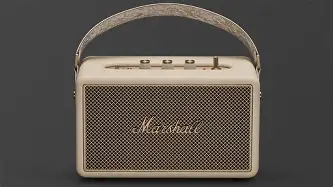
Bluetooth performance has been solid in day-to-day use. Pairing with my phone was fast and it remembered the device reliably. I occasionally observed slight audio/video latency while watching certain videos on my laptop via Bluetooth — nothing severe for music, but noticeable if you’re gaming or watching lip-synced video without using a wired link. There’s a wired AUX input for low-latency use, and I used that for a couple of video sessions where sync mattered.
One practical gripe: the Kilburn III doesn’t offer an extensive companion app or advanced DSP customization. You have the onboard tone controls and you can tweak EQ from the playing device, but if you want elaborate presets, multi-band EQ, or firmware-tuneable features, you won’t find them here. I missed an app when trying to tailor sound for specific rooms.
Portability & everyday use
The Kilburn III walks the line between portable and household speaker. It’s not lightweight like a pocketable Bluetooth speaker, but it’s still easily carried by the strap for short distances. I wouldn’t want to hike all day with it, but for city commutes, short walks, and car trips it’s very manageable. The build and materials make it feel like a speaker worth bringing out for guests rather than hiding on a shelf.
I also appreciated the tactile experience — turning the physical knobs while music plays feels more satisfying than tapping tiny icons on a phone. The knobs have a long throw and fine control, which made on-the-fly adjustments simple when swapping music genres during a party.
Everyday annoyances I encountered
- It’s not water-resistant, so I always kept it away from puddles and rain; that limits casual outdoor use in unpredictable weather.
- The lack of an app and advanced digital settings means less flexibility for EQ fans — I adjusted EQ at the source instead.
- At loud volumes outdoors, the bass loses some of its authority compared to indoor listening; I had to lower expectations for party-level bass.
- The speaker is heavy enough to feel premium, but that same heft makes it less ideal for long walks or backpacking.
Pros & Cons
- Pros:
- Characterful, musical sound with pleasing midrange and natural vocals.
- Premium, classic Marshall design and satisfying physical controls.
- Long battery life suitable for day trips and extended use.
- Good build quality that feels durable and substantial.
- Cons:
- Not water-resistant — cautious outdoors-only use required.
- Limited digital features and no comprehensive companion app for tuning.
- Bass can thin at very loud outdoor volumes.
- Heavier than truly portable alternatives.
How it compares to a few alternatives
Rather than a spec-by-spec shootout, here’s how the Kilburn III stacks up in practical terms against a few types of competitors I considered.
| Feature | Marshall Kilburn III (my experience) | Compact "pocket" speakers | Larger party/portable sub-equipped speakers |
|---|---|---|---|
| Sound character | Warm, mid-forward, musical — great for vocals and rock | Smaller, often bright or thin at low end | Big bass, louder, but sometimes less nuanced mids |
| Portability | Moderately portable — strap, solid heft | Excellent — pocketable or easily backpacked | Bulky — impractical for short walks but great for parties |
| Battery life | All-day use (18–20 hrs moderate) | Usually 8–15 hrs | Often similar or better, but heavier and larger |
| Durability/outdoor readiness | Good build, but not water-resistant | Many are IP-rated and rugged | Some are rugged and party-proof |
| Value for money (subjective) | Great if you prioritize sound character and design | Great for portability and casual use | Better for large gatherings and bass-heavy music |
Buying guide: is the Kilburn III right for you in 2026?
If you’re reading this in 2026, here’s how I’d decide whether the Kilburn III matches your needs. Ask yourself the following questions — I’ll explain why each matters based on my experience.
1. Do you want characterful, music-first sound?
If your listening leans toward vocals, acoustic, classic rock, or you simply appreciate a speaker that sounds like a “Marshall” (mid-forward and lively), the Kilburn III will reward you. I found it made many of my familiar playlists sound more engaging than generic-sounding portable speakers.
2. Will you mainly use it indoors or in covered outdoor spaces?
I used mine mostly indoors and in controlled outdoor conditions. If you need a speaker that can survive rain, sandy beaches, or an unpredictable campsite, consider water-resistant alternatives. The Kilburn III’s finish looks great indoors and it survived urban outdoor use, but I wouldn’t leave it out in the open during a drizzle.
3. How portable do you need it to be?
This is heavier and larger than pocket-sized speakers. If you want something you can carry all day, this might not be ideal. But if you want a speaker you’ll move occasionally and keep around the house or car, it’s comfortable to manage.
Discover deals on Audio & Headphones — updated daily.
View Offers →4. Do you value physical controls and an analog feel?
I loved the tactile knobs — they made changing the balance in real time intuitive. If you prefer touch controls and app-driven interfaces, you might miss the digital features the Kilburn III doesn’t provide.
5. Is battery life a priority?
Yes — the Kilburn III lasted me through long days of casual listening. If you frequently host all-day events or are away for extended trips without charging opportunities, it’s a dependable choice. If you require extreme portability and weight savings for ultra-long hikes, there are lighter options.
6. Do you want advanced connectivity features?
If you want multi-room ecosystems, voice assistants built-in, or a full-featured app, the Kilburn III is not aimed at that market. It’s a focused, straightforward speaker: tactile, great-sounding, and intentionally uncomplicated.
Final verdict
After six months with the Kilburn III, my honest take is that it’s a speaker for someone who values sound character, physical presence, and classic Marshall style more than app-driven convenience or ultralight portability. I appreciated how it made familiar playlists come alive, how satisfying the controls felt under my fingers, and how dependable the battery proved for day-long use.
My frustrations — mainly the lack of water resistance, limited digital features, and diminished bass at very loud outdoor volumes — are real, but none of them were fatal for my use case. If you plan to use the speaker as a kitchen/living room centerpiece, bring it to small outdoor gatherings when the weather’s fine, and care about an engaging sonic signature, I think the Kilburn III remains a compelling option in 2026.
On the other hand, if you need a rugged, waterproof speaker for unpredictable outdoor adventures, an ultra-light travel companion, or an ecosystem speaker with advanced app control and voice assistant integration, there are better fits. For what it does — deliver warm, enjoyable, and characterful sound in a premium package — it did exactly what I bought it to do.
Closing thoughts
In my experience, the Kilburn III is less about winning spec wars and more about an enjoyable, tactile listening relationship. It’s the kind of speaker you’ll leave out on a shelf because it looks and sounds good, not because you need it to be the loudest or the most feature-packed. If that matches what you want, I’d say it’s worth a serious look.